Learning English is fun

Learning English is fun
Showing posts with label Flashcards. Show all posts

Monday, 21 December 2015

The materials of our lesson planning.

THE CHINESE NEW YEAR

 Our lesson planning is about a typical Chinese festival celebrated in the United States. We have chosen The Chinese New Year because we think it is a positive way to introduce the Chinese culture in nursery education.
 I want to show you some of our materials:


The routines.

Flashcards used to talk about the dragon and the lanterns.

The head of our dragon.

Routines about feelings.

Flashcards about typical Chinese food.

Routines to check the roll.

The Happy New Year card.

The characters for the Mulan's story.

The Chinese fan.

The characters for the shadow theatre.

Flashcards about animals.

 I strongly recommend you to work with this topic in nursery education, because it is really interesting but at the same time an unknown theme and you can teach to your children the Chinese culture and many values using a big variety of activities. I'm sure your pupils will love it!

 I hope you have enjoyed the post and see you soon around here!

 M.R.M.

Sunday, 20 December 2015

The tenth lesson.

PLANNING FOR EFFECTIVE USE OF ENGLISH IN THE CLASSROOM

 As we have said in the other lessons, we can work and teach the second language to pupils as same as we do it in our mother tongue. So in this way we must provide them fun activities and situations in order to get a natural atmosphere, considering that in their daily life they learn playing, talking, touching,...

 But to make this possible it is necessary to speak them in English as much as possible.

 In the first point Helping children learn and improve the authors remind us several methods to use the English in class, for example to begin the session with routines, to give them easy instructions, to make a break, to talk about their personal lives and so on. It is really important too, the use of our body and the intonation when we are explain something or when we are talking with them.

 On the other hand, we can utilize the first language (Spanish) when children have one problem to comfort them or when they don't understand what we say. Also we use the recasting if they are talking in their mother tongue, for example repeating in English what they were saying in Spanish, in order to improve their English skills and to show our pupils that we understand them.

 As we have mentioned in many times, if one child makes a mistake the best way to correct him it is repeating in a better English, since they will learn the right way to say something and their self-esteem won't be wounded.

 In the second point Using your coursebook as a resource, they tell about the coursebook can be a support and help us in our planning. We can work the contents and activities that the book suggests but also we can add other topics related with them. For example we teach them using flashcards, pictures, video recorders, stories, games or working with festivals. We must always keep in mind the age and level of our students.

 In the last point, Planning your lessons, we have seen that we have to prepare before the English sessions and make sure about the space available in order to design the activities. We have to reflect on the knowledge of our students, the way they learn, the order of the activities, the resources we have, the groupings, if we want to follow a pattern (first routines, later introduce the topic with flashcards, review the topic with song, a break, the main activity, bye bye song),...

 To end, if we want they improve their English, we must repeat a lot, speak slowly, tell about interesting and attractive topics for them and encourage and reinforce them when they take part in the class.


  See you soon my friends!

 M.R.M.

The eighth lesson.

READING AND TELLING STORIES

 Assuming that children love tales and the fact that tell them stories, we can take advantage of this and using it to teach them values, to introduce another culture, work with the feelings and emotions, to review vocabulary,...
 However, telling stories to very young learners is not easy, for that it is pretty important to adapt it to their cognitive development and their English level and to employ the intonation, the gestures and our body language in order to make easier the understanding.

 In the first point, Telling a new story, they tell about when we tell a story for the first time we must explain the new vocabulary and revise the words they have already learnt using pictures or flashcards. Later when we are telling the story we use a basic and easy language and we can help us with gestures since in this way they understand better the tale. 
 Moreover, when story ends encourage your pupils asking them questions about the story.

 In the second part, Reading a story to very young learners, we have learnt that when we read a tale to the students we must show them the pictures or real things to help them to understand. Also we can make the sounds and mime the actions, because children love them and later we ask or answer questions about the narration. 
 If there are difficult or key words we must repeat them to avoid breaking the yarn of the story.

 In the third point, Ways to retell a story, the authors explain that if we have already told a story in class and we want to tell it again, we can motivate their involvement asking them that mime the actions, point the right picture or correct in groups the mistakes. In addition they can tell among all of them the story, obviously with our help.

 And finally we have the fourth part, Retelling a story as a class. As i have said above, we can let them tell the story and they will count with our help when they need it. 
 But also, we can provide them the opportunity to tell the story from another point of view. They will invent and add some aspects to the original tale. It will be really positive and enriching for their imagination and creativity and for their confidence to do things in English.

 To finish, I want to show you an incredible book to work in English with stories and much vocabulary with your very young learners.


The very hungry caterpillar's book.

 That is all for today. I hope you have enjoyed with the post!
 See you!

 M.R.M.

Wednesday, 4 November 2015

The second lesson and my own flashcards.

                                                     LISTEN AND DO

 Good afternoon to everybody!

 This time, I'm going to tell you about the second lesson. In it, we´ve learnt how use "Listening and do". So we can give instructions in English to children like sit down, move around or stand up. Maybe at first they don´t understand us so much, thus It´s really important helping of our body language with gestures, for example.

 On other hand we could work "Listening and identifying", where pupils had to recognize and point several objects, clothes, colours, classroom furniture, and so forth, which teacher has mentioned.

 This is so positive, because they practise listening, improve vocabulary and they associate sound with the meaning itself. In addition, you can encourage good behaviour and introduce grammatical notions teaching them the singular and plural or the gender, for example with simple sentences: I have one pencil, MarĂ­a has two pencils.

 Furthermore, in nursery education we can´t forget Total Physical Response through "Listening and doing". Children must follow instructions are given by the teacher, so they love it because it´s like a game and they´re enjoying with that. 

 It's easy to understand for the reason that movement and language go together. You can choose between many kind of activities and use them in different situations: To follow the leader, to make a break, to work routines, to arrange the class, to work vocabulary,...

 Besides, we can work the mime, with Listening and performing/ miming  activities, for example using a topic that children know really well. So we will give them some instructions, depending on the progress or the level they will be more complex or easier, and then they must mime those actions. We can choose many real situations like a typical morning routine, songs, stories, chants, ...

 Or the Listening and responding games, where pupils need to pay attention while teacher is explaining and telling them they must do. For example games like "Simon says" or to identify if a thing is wrong or right.

 To end, in our lessons it is pretty important we speak slowly to children and repeat a lot, so they get understand all much better. And the other hand we must bear in mind that we can use the mother tongue in specifics situations when we need to explain an activity or to comfort a child, for example.

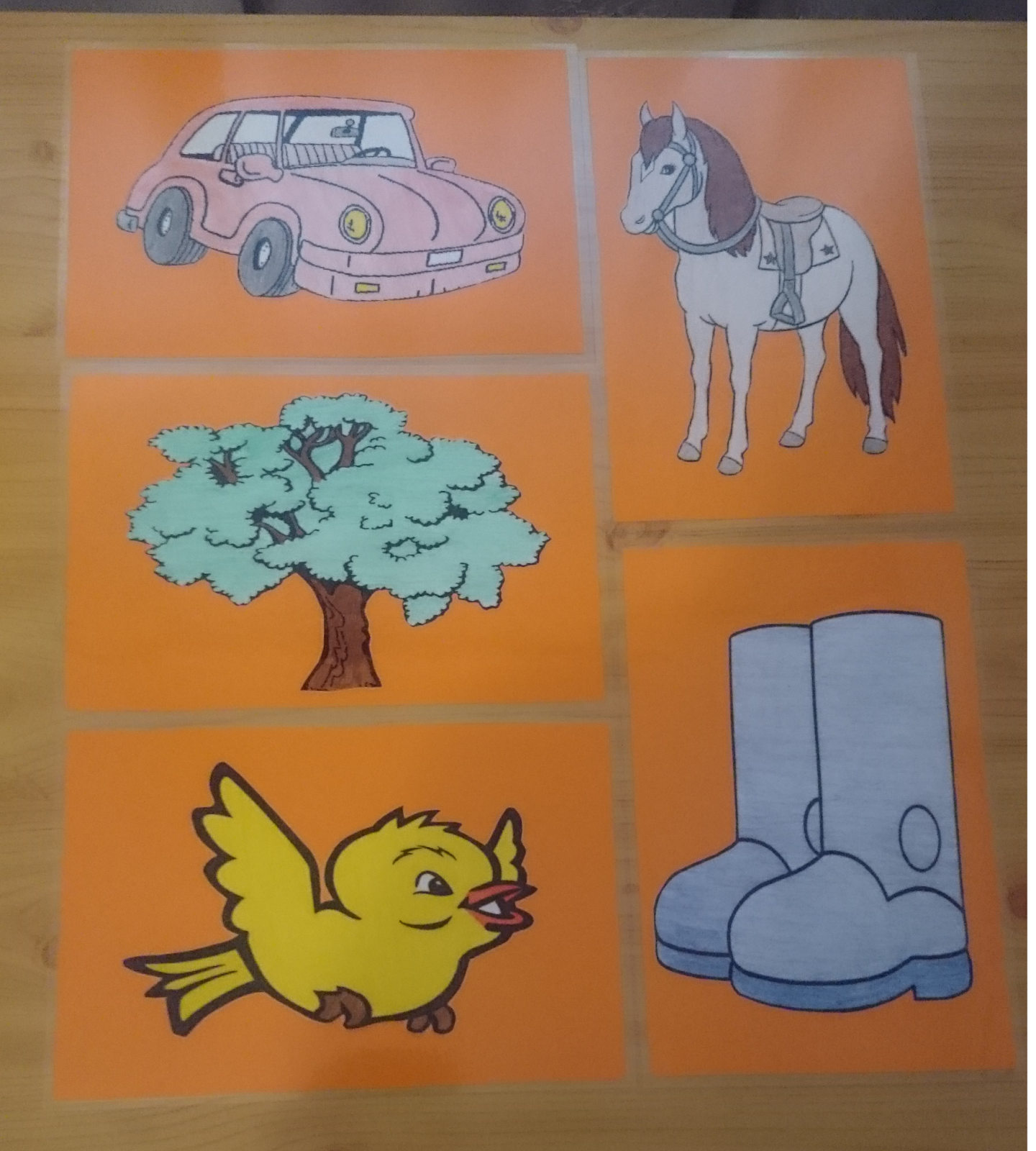
 In addition, i want to show you the flashcards i use in classroom in order to work and improve the pronunciation. Children can use and touch them, so I have decided to laminate the flashcards in order to avoid they can break them. So in this way I will be able to use them for a long time.


Long vowels


Long vowels


Short vowels


Short vowels


Consonants


Consonants


 See you!
 M.R.M.